Stability and age-specific patterns of rhinovirus circulation in children observed over 3 decades
Abstract
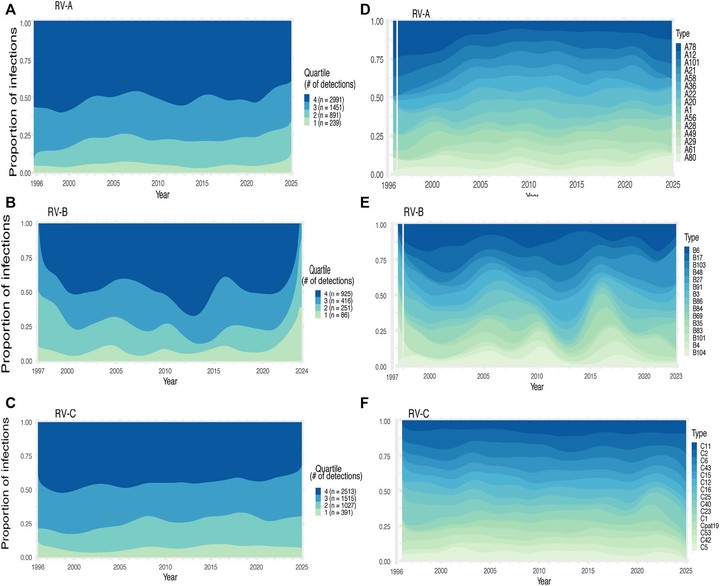
Background Rhinoviruses (RV) are the most common respiratory viruses globally and a major cause of airway symptoms in children and individuals with asthma. Although more than 170 RV types exist across 3 species (RV-A, RV-B, RV-C), type-specific circulation patterns and age-related prevalence remain poorly defined. Objective We characterized long-term circulation patterns, age-specific prevalence, and host genetic associations of RV types using a large pediatric dataset. Methods We retrospectively analyzed 12,697 RV infections identified by PCR and partial sequencing from 11,960 nasal samples collected between 1997 and 2025 across 20 pediatric populations in Finland, Australia, and the United States, including 10 National Institutes of Health ECHO cohort sites. RV types were classified by species, and host CDHR3 rs6967330 genotype, which impacts RV-C receptor binding, was available for a subset. Temporal stability, phylogenetic clustering, and detection frequency by age were assessed by stream graph visualization, slope modeling, and Spearman correlation. Results RV type circulation was remarkably stable over 3 decades; 97% of types had slope estimates whose 95% confidence intervals included zero, indicating no significant temporal change. Commonly detected types did not consistently cluster phylogenetically, suggesting that capsid sequence similarity does not fully explain fitness. Certain types (eg, A36, A101, C15) were prevalent across all pediatric age groups, whereas others (eg, C2, C40, A78, A12) were more frequent in younger children. The CDHR3 rs6967330-A risk allele was associated with increased overall RV-C infection but it did not alter the distribution of common versus rare RV-C types. Conclusion RV type prevalence and age-specific patterns have remained stable for decades, supporting targeted interventions focused on consistently circulating types and those most common in young children.