Identifying clinical and lifestyle factor mediators of the association between socioeconomic status and colorectal cancer mortality
Abstract
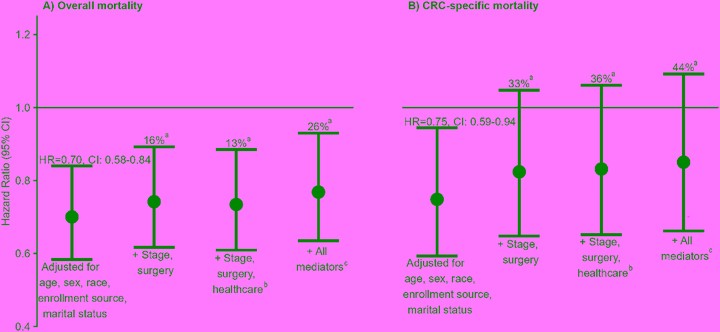
Purpose Higher SES is associated with lower mortality among colorectal cancer (CRC) survivors. We performed a mediation analysis to identify factors that mediate the association between household income and CRC mortality. Methods Data arise from 1038 participants of the prospective Southern Community Cohort Study (SCCS) who developed incident CRC after enrollment (2002-2009); 73% self-identify as Black. Fifty-nine percent self-reported household income <$15,000/year. Mortality outcomes were determined via the National Death Index. Proportional hazards models were used to estimate hazard ratios (HRs) with 95% confidence intervals (CIs) for mortality by income level. Mediation analysis was used to estimate indirect effects of stage, healthcare-access and use, comorbidities and health behaviors on mortality. Results Higher income was associated with lower risk for all-cause mortality (≥$15,000 vs. <$15,000/year: HR = 0.70, 95%CI:0.58-0.84) and CRC-specific mortality (HR = 0.75, 95%CI:0.59-0.94). Differences in stage and surgical resection together explained 33% of the association with CRC-specific mortality and 16% for all-cause mortality. Smoking history explained 11% of the association with all-cause mortality and 9% for CRC-specific mortality. Diet explained 9% of the association with each outcome. Adjustment for all potential mediators explained 26% and 44% of the associations with all-cause and CRC-specific mortality, respectively. Associations between income and mortality were similar for participants with local/regional tumors only. Conclusions Differences in early detection and surgical resection are the strongest mediators of the association between income and mortality. SES-targeted health policies and patient navigation will improve CRC outcomes. Additionally, health policies to address smoking cessation and food availability will create opportunities for interventions to promote health equity.