Abstract
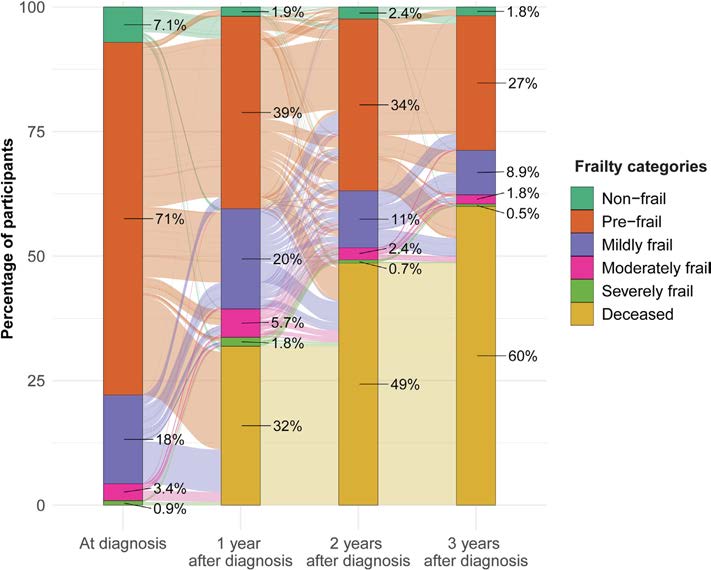
Objective Leading oncology societies recommend assessing pre-treatment frailty to guide care for older adults with cancer. However, frailty may change post-diagnosis. This study characterized post-diagnosis frailty and its association with overall survival among older women with ovarian cancer. Methods We included 24,725 women aged 65+ diagnosed with ovarian cancer between 2000 and 2019 from Surveillance, Epidemiology, and End Results (SEER)-Medicare. Frailty was quantified at diagnosis and 1–3 years post-diagnosis using a validated claims-based index. We compared patients’ frailty at the beginning and end of each year. At 1, 2, and 3 years post-diagnosis, we fit a Cox proportional hazards model including frailty at diagnosis and current frailty to assess associations with survival. Results Frailty distribution at diagnosis was: 7.1% non-frail, 71% pre-frail, 18% mildly frail, 3.4% moderately frail, and 0.9% severely frail. During year 1, 38% of women maintained frailty status, 4% improved, 26% worsened, and 32% died. In years 2–3, some women remained stable while others improved or worsened. There were 21,309 deaths during a median follow-up of 25 months (interquartile range 7–58). Frailty at diagnosis was not associated with survival after adjusting for current frailty (hazard ratios [HRs] for severely frail versus non-frail =0.98, 1.00, 0.76 at 1, 2, 3 years, respectively, all p-values>0.20). Current frailty was strongly associated with survival, and the association increased over time (HRs =2.26, 2.77, 3.70, respectively; all p-values<0.001). Conclusions Post-diagnosis frailty is dynamic. Current frailty has a stronger association with overall survival compared to frailty at diagnosis. Repeated frailty assessments should be incorporated into clinical practice.