Optimizing Facility-Specific Urinary Weighted-Incidence Syndromic Antibiograms for Nursing Homes
Abstract
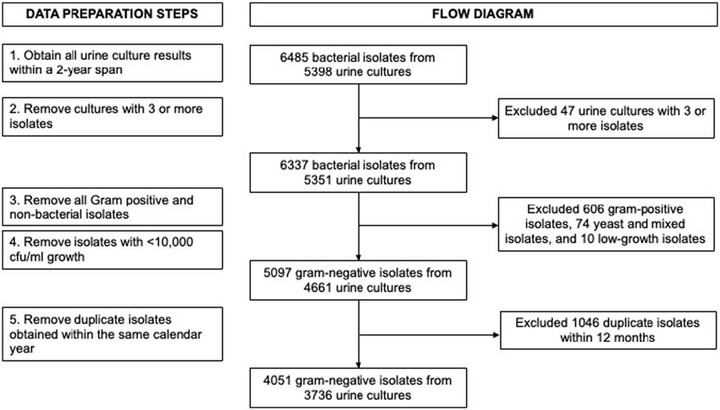
Objective: To develop an approach for creating facility-specific urinary antibiograms accounting for the low number of isolates recovered in nursing homes (NHs). Design: Retrospective analysis of urine culture data collected in NHs in five states. Setting: Data on 5097 urine culture isolates collected across 59 study NHs from January 1, 2020 to December 31, 2021. Four consulting microbiology laboratories served the study homes. Methods: We compared a Clinical and Laboratory Standards Institute (CLSI) standard antibiogram model to four weighted-incidence syndromic antibiogram (WISCA) models utilizing alternate formatting rules. Ability to produce a facility-specific antibiogram with at least 30 isolates and the impact on susceptibility predictions were compared. Results: Only one facility could generate a CLSI standard antibiogram for the three most commonly recovered Gram-negative isolates over a one-year period. Ability to generate an antibiogram increased with each of the four WISCA models trialed (36%, 54%, 85%, 85%) with the most successful models combining all Gram-negative isolates over a two-year period. Shortening the definition of duplicate isolates from 12 to 3 months did not improve performance. Using all Gram-negative isolates, rather than the three most recovered pathogens, resulted in meaningful changes in the predicted activity of ampicillin-sulbactam, cefazolin, ceftriaxone, and trimethoprim-sulfamethoxazole in several study NHs. Conclusions: These results suggest that WISCAs using 2-years of urinary culture data including all gram-negative isolates and excluding duplicate isolates within twelve months maximizes the number of NHs able to create a valid antibiogram.